Serving Clayton, Archer Lodge, Flowers Plantation, and the rest of Johnston County with pumping, inspections, repairs, and new systems.
Call (555) 555-5555Or call — we answer. No obligation, honest advice.
Johnston County keeps topping the growth charts for North Carolina, and Clayton is where most of that growth lands first. What the headlines skip is the plumbing underneath it: step outside the town's sewer footprint and nearly every home from Archer Lodge to Wilson's Mills runs on a septic system. New subdivisions on former farmland, older houses on family acreage, big lots along Covered Bridge Road and out toward Cleveland — thousands of tanks quietly doing their job until the day one doesn't.
Trusted Clayton Septic Pros handles that day, and the years in between it. Pumping on a sensible schedule, inspections when a house changes hands, repairs when an alarm goes off or a drain slows, and full installations for new construction and failed systems. Every job starts with a diagnosis and a written price, in that order.
Call (555) 555-5555 for a free estimate. Phones get answered, windows get kept, and nobody quotes a drain field when the actual fix is a forty-dollar baffle.
Clayton sits right where the Piedmont hands off to the Coastal Plain, and the soil knows it. East of town you'll hit sandy loam that drains almost too well; west and in the creek bottoms you find tighter clay pockets that barely perc at all. Two houses a mile apart can need entirely different drain field designs.
That's why Johnston County requires a soil evaluation before anyone digs, and why a system designed for the wrong soil fails early. Knowing which ground you're standing on is half the trade here.
Pumping, inspections, and installation-and-repair cover most of what a Johnston County septic system will ever need. Each links to its own page with the details.
Full pump-outs with the lids uncovered, baffles and tees checked, and a written condition note before the truck leaves. Most homes here need it every three to five years.
Real-estate and routine inspections with a written report — tank, baffles, pump, and field — sized for how fast Johnston County closings move.
Soil evaluation through final county inspection for new systems, and diagnosis-first repair for alarms, backups, odors, and wet spots in the yard.
Wastewater leaves the house, solids settle in the tank, and the clarified water moves out to the drain field where the soil finishes the treatment. Every part of that chain depends on the part before it: a full tank pushes solids into the field, and a clogged field backs everything up toward the house.
Pumping exists to protect the drain field, because the field is the expensive part. On Clayton's clay-pocket lots that math is even sharper — a replacement field in tight soil can mean an engineered system, not just new trenches.
If you can't remember your last pump-out, that's the answer to whether you're due.

Septic work in Clayton runs through Johnston County Environmental Health in Smithfield, and their process has real teeth. Before any evaluation happens, you need a site plan showing the house, well, driveways, and any outbuildings. The county evaluates the soil, and if the lot passes, a survey and plat may be required before the permit is released.
Here's the wrinkle that surprises builders: for homes going up on slab or stem-wall foundations, the county requires a grading plan on the septic site plan — limits of disturbance, cut and fill, diversion swales. Grade carelessly around a home site and the disturbed ground can encroach on the approved septic area, and the county can revoke the permit, which triggers a stop-work order from building inspections. On a construction loan clock, that's an expensive way to learn where the drain field was.
Two more county specifics worth knowing. Repair permits are free and can be filed by the owner or an agent, so there's no fee excuse for leaving a failing system alone. And if your system uses an effluent pump, the county inspects it every five years under state rule — a letter arrives in the mail, and the appointment is on you to schedule.
None of this is red tape for its own sake. It's the county trying to keep thousands of new systems from failing young in soil that varies lot to lot. A contractor who works here weekly should be walking you through it, not learning it on your invoice.
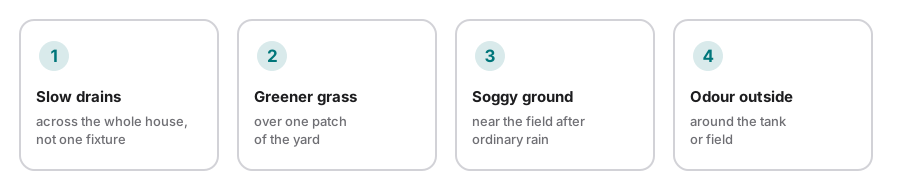
Slow drains, gurgling, sewage odor, or a soggy green stripe over the drain field — septic systems announce trouble early if you know the signals.
The same order of operations on every job in the county, from a routine pump-out at Flowers Plantation to a failed field on family land.
Someone looks at the actual system before a number exists. You never pay drain-field money for a baffle problem.
The quote is written down before work starts, with what it covers spelled out. Changes get discussed, not discovered.
Site plans, county permitting, and inspection scheduling managed start to finish, so your project keeps moving through Smithfield.
Clayton's building boom pulls in two directions at once. New construction east of town needs full system design in fast-draining sand, where the risk is undersizing. Established neighborhoods and the acreage between Clayton and Cleveland run older systems in heavier ground, where the risk is a field that was marginal the day it was installed and thirty years of deferred pumping since.
Real estate moves fast in this county, and septic surprises kill closings. A pre-sale inspection with a written report costs a fraction of the price reduction an unknown system forces at the negotiating table. Buyers coming from city sewer, often relocating for the Triangle, usually don't know what questions to ask — the report asks them for you.
And a note on verification that applies to every contractor, including this one: North Carolina certifies septic installers and inspectors through the state's on-site wastewater program. Ask any contractor for their certification number and look it up before they dig. Ask for a certificate of insurance sent directly from the insurer, not a photocopy from a truck. A legitimate operator will treat those questions as routine, because they are.
Based in Clayton and covering the growth corridor of Johnston County — the neighborhoods off NC-42, the Archer Lodge and Wilson's Mills communities, Flowers Plantation, and the rural roads toward Smithfield and Four Oaks.
If you're on a septic system anywhere in the county and unsure whether you're in the service area, call. The answer is almost certainly yes.
Johnston County's front door on the Raleigh side, and the fastest-growing corner of a fast-growing county.
The three-to-five-year rule is a starting point, not a law of nature. A retired couple on a big tank can stretch it; a household of six with a garbage disposal cannot. Water usage, tank size, and what goes down the drain set the real schedule, and a pump-out with a condition check is how you calibrate it for your house instead of guessing.
What shortens the interval fastest: garbage disposals, water softener backwash plumbed into the tank, and treating the toilet like a trash can. What a pump-out can't fix: a drain field already saturated by years of overloading. That's the conversation nobody wants, and the one an honest diagnosis has early instead of late.
Whether it's a routine pump-out, an alarm at 7 a.m., a closing on the calendar, or a new build waiting on a permit, the first step is the same: call (555) 555-5555, describe what's happening, and get a free estimate with a real arrival window.
Septic problems get cheaper the earlier they're caught. The call costs nothing.
Tell us what you need and we'll get back to you with a real answer. If it's an active backup or standing water over the field, calling gets you a faster response.
Call: (555) 555-5555
Area: Clayton, NC and Johnston County